ChatGPT Ads in Bulgaria: The Ad Sits Under an Answer You Can't Buy
Since 12 November, a Bulgarian company that wants to advertise inside ChatGPT can sign a contract with a local partner, get an invoice in its own currency and talk to a support team in its own language. On that day OpenAI named Aleph its exclusive reseller for ChatGPT Ads in 44 countries, Bulgaria among them. Bulgarian business media picked it up this morning, with Darik Business Review headlining that OpenAI is "expanding ChatGPT Ads in Bulgaria."
That headline is easy to misread. Ads in ChatGPT have been on sale in Bulgaria since the end of August, and last week's deal added a local way to buy them. For a marketing director deciding whether to put budget into this channel, the difference matters, and so does a detail of how these ads are placed that gets far less attention than the reseller deal.
What actually changed on 12 November
OpenAI's own announcement is precise. Brands and agencies based in the 44 listed markets can now "contract, pay and get local support" through Aleph. Aleph offers local invoicing in local currency, payment terms, onboarding, campaign support and training. The European and Central Asian group has 16 countries, including Bulgaria, Romania, Croatia, Czechia, Hungary and Slovenia.
OpenAI also states what did not change. The deal "does not impact any advertisers ability to target any of these countries in a campaign." Companies can still buy directly through OpenAI's self-service Ads Manager or through OpenAI's global technology partners. According to the same post, more than one hundred thousand marketers have advertised on ChatGPT so far.
What was already true before
ChatGPT Ads expanded to 31 European markets in late August. Self-service access followed on 31 August, and OpenAI's Ads Manager availability list shows Bulgaria as available. A Bulgarian company could already create an account and run a campaign. The reseller adds a local contract and local support on top of that.
The rules on who sees the ads are set out in OpenAI's help page on ads in ChatGPT:
- Ads appear only for users on the Free and Go plans. Plus, Pro, Business, Enterprise and Edu accounts see no ads.
- Accounts identified as belonging to people under 18 see no ads, and Temporary Chats show none.
- Ads are not eligible to appear next to sensitive topics such as personal health, mental health or politics, and political advertising is not allowed.
- Personalized ads are not initially available in the European Economic Area or Switzerland. For a user in Bulgaria, the ad is chosen mainly from the current conversation and basic context such as general location and language.
One consequence for B2B companies is easy to miss. If your target buyers work in firms that give them ChatGPT Business or Enterprise, they will not see your ad on their work account. They may still see it on a personal free account in the evening.
Where the ad sits
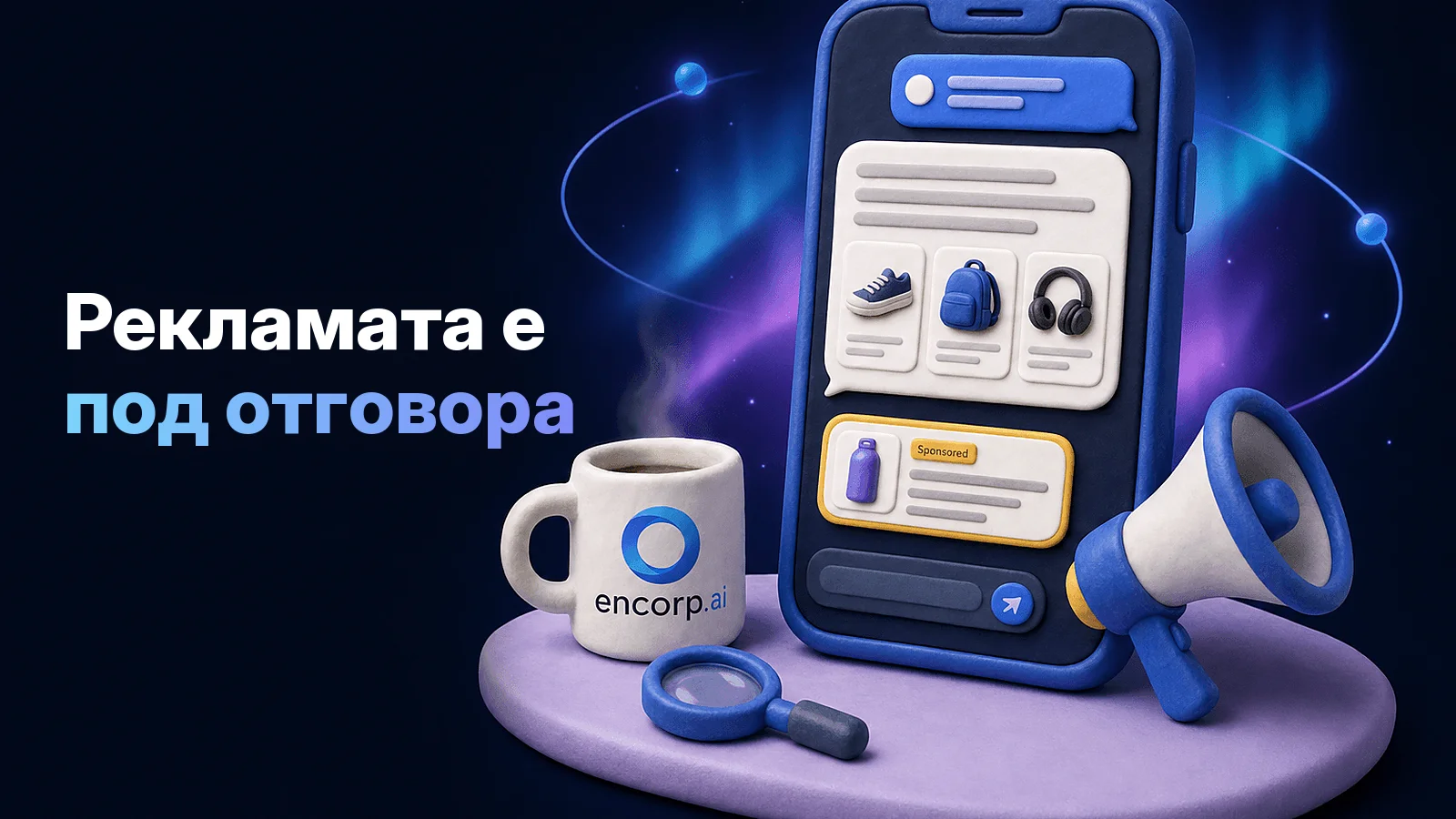
The most important sentence for advertisers is in OpenAI's ads principles, published in January: "Ads do not influence the answers ChatGPT gives you." The help page repeats it and adds that ads run on separate systems from the chat model, and that advertisers "have no ability to shape, rank, or alter ChatGPT's responses." In practice, the ad is one labelled unit shown below a response. OpenAI is also testing a visual format during image generation.
So the screen a buyer sees has two parts. At the top is an answer that nobody paid for. Below it, clearly separated, is the one thing that was paid for.
The half of the screen you cannot buy
What follows is my interpretation of these rules.
The ad slot is the smaller half of that screen. When a buyer asks ChatGPT to compare suppliers in your category, the answer may already name three companies and explain why each fits. If your company is not among them, your ad appears directly under a recommendation for your competitors. You can pay for the space under the answer. You cannot pay for the answer.
That changes the order in which I would spend effort. First, find out what ChatGPT and similar assistants say today when someone asks about your category in Bulgarian and in English. Then fix what you can influence: whether your website explains clearly what you do, for whom and in which regions, and whether credible third parties describe you consistently. We covered that side in our earlier piece on how AI answers change the rules of search. Only after that is a test budget for ads easy to justify, because you know what the ad has to work against.
This is also why the lack of personalization in the EU matters more than it seems. Without behavioral targeting, the ad depends on the conversation itself: the question the user asked, the answer they got and how well your offer fits that moment. A company that understands the questions its customers really ask is better placed for the ad and for the answer above it.
One afternoon of testing (a hypothetical case)
Imagine a Plovdiv manufacturer of commercial refrigeration equipment that sells to shops and restaurants in Bulgaria and Romania. Its marketing manager hears about the Aleph deal and considers a first campaign.
Before signing anything, she spends an afternoon testing. On a free account she asks ChatGPT, in Bulgarian and in Romanian, the questions a restaurant owner would ask: which refrigerated display cases are reliable for a small shop, who services them in Plovdiv, what to look for in energy consumption. She writes down which companies the answers name and which websites they cite.
Suppose the answers mention two importers of foreign brands and none of the local manufacturers. That tells her something more useful than any media kit: the company is invisible at the exact moment a buyer is deciding. She can still run ads. But she also knows the website needs pages that answer these questions directly, with service areas and technical data stated plainly, and that an ad under an answer recommending competitors has a harder job.
If the answers already name her company, the picture is different. An ad under a favorable answer reinforces it, and a modest test makes sense sooner.
What to check before a first campaign
If you decide to test, a few practical points follow from OpenAI's own rules:
- Decide who you want to reach. Business and Enterprise users see no ads. If your buyers sit in large firms with company accounts, reach on work devices will be limited.
- Write for the conversation. In the EU the ad is matched mainly to the current chat. Landing pages and ad copy that answer a specific question will fit better than generic brand messages.
- Treat the local contract as a convenience. Buying through Aleph gives local invoicing and support. Self-service Ads Manager remains open if you prefer to run campaigns in-house.
- Measure the answer as well as the ad. Repeat the same set of questions every month and record whether your company appears. That trend says more about your position than click-through rates.
The reseller deal makes ChatGPT easier to buy as a media channel in Bulgaria. It leaves untouched the part of the screen that decides most outcomes. Start by reading that part carefully.