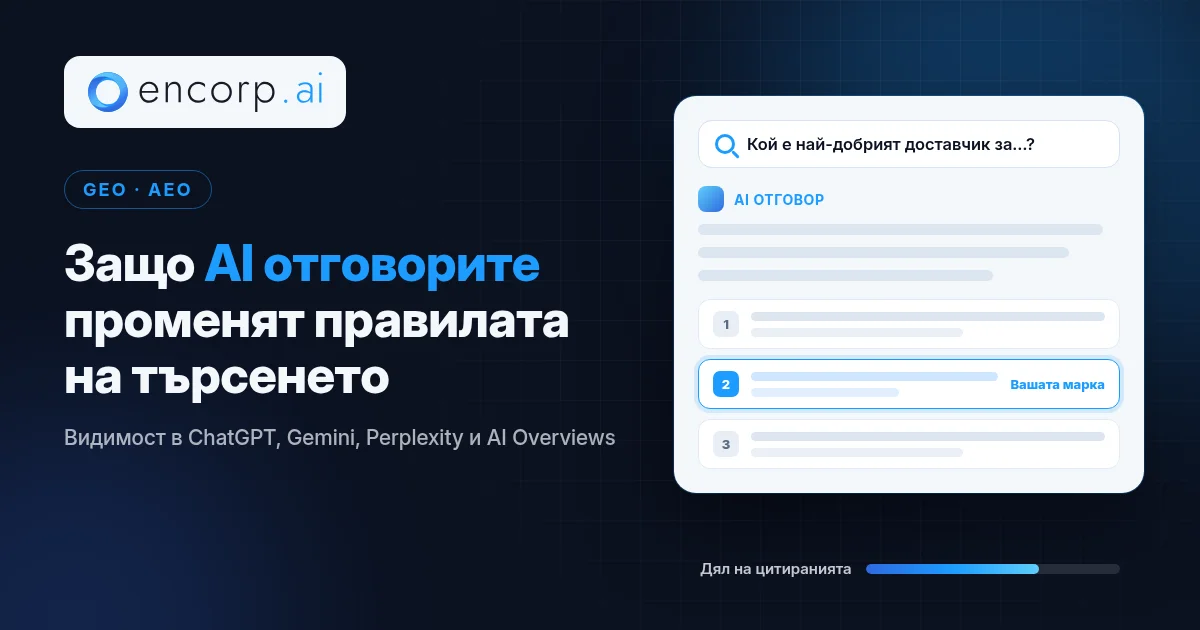
Why AI Answers Are Changing the Rules of Search
Until recently, a typical B2B research journey started on Google: ten blue links, a few open tabs and a comparison sheet in Excel. Today more and more buyers start with a single question to ChatGPT, Gemini, Perplexity or Google's AI Overviews. They get a ready answer with three or four recommended vendors and rarely reach the second page of results. If your company is not in that answer, for that buyer it simply does not exist.
Buyers ask AI before they ask you
The shift is already visible in the data. In G2's State of AEO 2026, based on 153 interviews with B2B marketing decision-makers, 76% say AI answer engines are becoming buyers' first research step, and 43% say they already are the primary first step. At the same time, 75% have only partial or manual visibility into how these systems describe their brand.
In other words, your customers are already getting an opinion about you from AI, and most companies do not know what it is.
Here is what that looks like in practice. The CFO of a manufacturing company asks ChatGPT: "Which warehouse management software suits a mid-sized manufacturer in Bulgaria?" The answer lists four solutions, explains their strengths and cites articles, reviews and comparisons. The buyer builds a shortlist before visiting a single website. If your product is not among the four, you lose the deal at a stage you never see in your CRM.
GEO and AEO: the new SEO
The discipline that responds to this shift is called GEO (Generative Engine Optimization) or AEO (Answer Engine Optimization). The goal is no longer only to rank first in a list of links, but to be mentioned, cited and recommended in the answer itself.
This is not a niche topic. According to the State of GEO report by GNW Consulting and Demand Metric, among 225 B2B marketing and revenue leaders, 92% of organizations are already experimenting with GEO (48%) or operationalizing it (44%).
It is important to understand that GEO does not replace SEO, it builds on it. AI Overviews and AI Mode rely on Google's index, while ChatGPT and Copilot use Bing's index. A page that is not indexed and does not contain a clear answer as text cannot be cited.
How to measure visibility in AI answers
In classic SEO we track rankings and clicks. In GEO the core metric is share of citations: in what percentage of answers to a fixed set of buyer prompts your brand appears, compared with competitors.
How it works in practice:
- Build a list of 30 to 50 questions your real customers ask. Take them from sales calls, inquiries and meeting notes, not from a keyword tool.
- Run them regularly in ChatGPT, Gemini, Perplexity and Google AI Overviews.
- Record who is mentioned, who is cited as a source and how each brand is described.
Example: an accounting services firm tests 40 prompts such as "How do I choose an accounting firm for an IT company?". It turns out it is cited in 3 of 40 answers, while its main competitor appears in 14. That is the baseline. After three months of work, the same prompt set shows whether the share is growing.
The key is that the set stays fixed and has an owner. According to G2, only 29% of companies maintain a structured prompt set with a named owner and a refresh cadence. Without that, measurement turns into random spot checks.
Practical steps you can start this month
1. Check whether AI crawlers can see your site at all. Review robots.txt. OAI-SearchBot, PerplexityBot or Google-Extended are often blocked by accident, or content loads only through JavaScript and crawlers see an empty page.
2. Write answers, not ad copy. AI systems cite pages that answer a question directly. A service page that opens with a clear sentence about what you do, for whom and with what result has a far better chance than a page full of generic slogans.
3. Add structured data. Schema markup for your organization, services, articles and FAQs helps the systems understand who you are and what you offer.
4. Be where AI gets its information. AI answers often cite independent sources: industry media, comparison articles, review platforms and forums. A feature in an authoritative publication or a well-maintained vendor directory profile often carries more weight than yet another post on your own blog.
5. Keep content fresh. Current data, dates and concrete numbers make a page a more reliable source. A 2023 article with outdated facts is rarely cited.
6. Connect visibility to business results. Separate AI-referred traffic in your analytics and track how it converts. That is how GEO stops being an experiment and becomes a channel with measurable impact.
How Encorp.ai helps
At Encorp.ai we offer an SEO, GEO and AEO audit that checks how Google, Bing and the AI assistants ChatGPT, Gemini, Copilot, Perplexity and Claude see, rank, cite and recommend your site. We assess representative page templates, test real queries live and deliver a PDF report with concrete findings and an action plan ordered by impact. After the fixes, the live test is repeated so you can see the real change.
Start with one question
Open ChatGPT and ask the question you hear most often from your customers. If your competitors are in the answer and you are not, it is time to act.
Contact the Encorp.ai team and we will show you how you look in AI answers today and what to change to get cited more often.