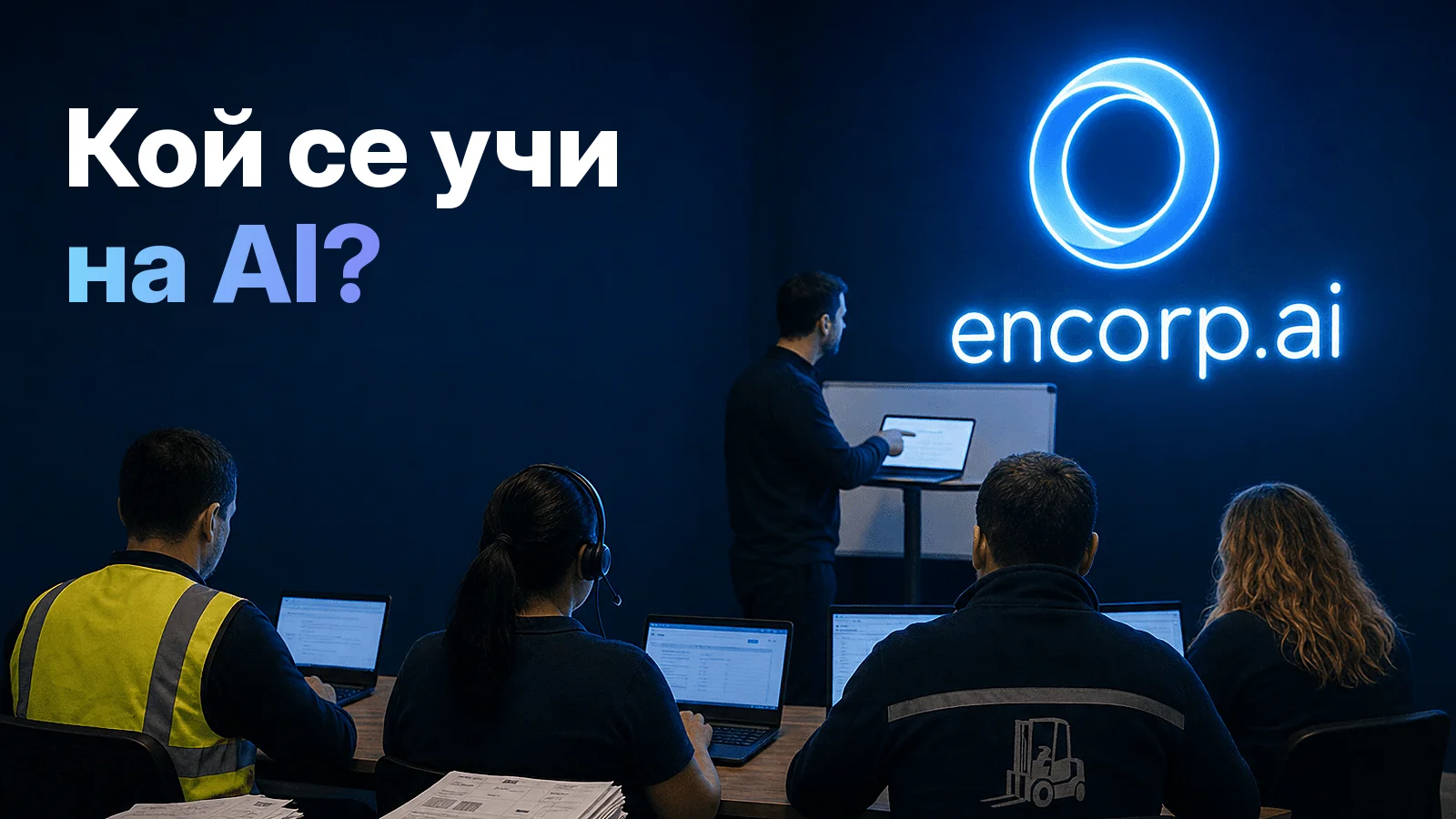
AI Training Goes to Executives First. The People Doing the Work Wait
Seventy-eight percent of executives say their employer offered them AI training in the past year. Among hourly workers the figure is 20%. Those two numbers come from Marsh's 2026 HR Technology's Impact on the Workforce study, published on 18 November and based on a July survey of more than 6,700 employees in ten countries. The same study finds that 64% of executives use AI regularly in their work, compared with 20% of entry-level professionals.
A day later, the Adecco Group published its Global Workforce of the Future 2026 report, a survey of 40,500 workers in 36 countries carried out in June and July. Bulgaria is in the sample, according to the methodology note. Its headline on skills points the same way: 66% of workers say AI has changed the skills their job requires, yet participation in AI training fell from 77% in 2025 to 67% in 2026.
Read together, the two surveys say something uncomfortable for anyone planning next year's budget. The gap in AI use inside a company largely follows the line of who was taught, and the training that exists is concentrated at the top of the org chart, where people already had the most support.
What the numbers actually show
Marsh's figures describe a fast rise with a thin layer underneath. 71% of employees have used AI in their jobs, up from 39% in 2024, but only 37% use it regularly. Use varies a lot by sector: 59% of people in high-tech and IT use it regularly, against 22% in healthcare and 19% in government.
The training split is the clearest part of the report. After the 78% of executives, the share offered AI training drops to 44% for experienced professionals, 32% for entry-level staff and 20% for hourly workers. Confidence follows the same slope. Nine in ten executives say they are confident doing their job well with AI tools; among hourly workers it is five in ten.
Adecco adds a comparison inside the group of AI users. 93% of those who completed training say AI has made them more productive. Among those who did not, it is 47%. Workers whose employers involve them in redesigning their work are far more willing to adapt (96% against 29%), and 92% of those whose leaders explain how AI will change their role are comfortable with the change, against 15% where nobody explains.
What the numbers don't show
All of this is self-reported, and none of it is a controlled experiment. People who get training are often the ones who were already curious, or who sit in roles where AI fits easily. So "93% of trained users feel more productive" does not prove that a course produced the gain. Some of the gap would probably exist without any training at all.
Marsh's ten countries are Canada, France, Germany, Japan, Mexico, Saudi Arabia, Singapore, the UAE, the UK and the US, so its numbers say nothing directly about Bulgaria. Adecco does include Bulgaria, but its press release gives no country breakdown, and the Bulgarian picture could differ in either direction.
What the two studies do support is a pattern, not a precise size. When two independent surveys of very different groups both find that AI use and AI training fall away as you go down the hierarchy, and one of them finds training participation shrinking, that pattern is worth taking seriously.
Why I read it as a training problem
The most useful passage in the Marsh release is about which skills matter. It argues that most companies train technical skills, while the skills that decide whether AI use turns into better work are judgment, critical thinking and context. Executives, it says, have had more time and support to build those, including mentoring and sandbox environments to practise in. Further down the organisation, that investment has not been made.
That matches what the use gap looks like on the ground. Knowing which button to press in ChatGPT or Copilot takes an hour. Knowing when the answer is wrong for your customer or your contract takes practice on your own tasks, with someone who can say "this part you check, this part you can trust". A login and a recorded webinar do not provide that.
The communication numbers point the same way. In Marsh's survey, one in three employees say no one has discussed AI's impact on their role or department, and among those who heard something, only 21% heard it from their direct manager. Adecco finds that only 39% of workers feel supported by their manager to adapt.
Untrained does not mean unused
It would be easy to conclude that people without training simply don't use AI. Marsh suggests otherwise. More than one in five employees use AI tools their employer did not supply, non-compliance with company AI guidelines has nearly tripled in two years, and more than one in ten say their organisation has no guidelines at all.
Among employees who strongly agree that they have adequate digital tools, 84% use company-supplied AI and 85% follow the guidelines. Among those who strongly disagree, the figures are 42% and 54%. My interpretation: when the company doesn't teach and equip people, a good share of them still find a way, just outside the rules. Cutting training below management level does not remove the risk. It moves it to personal accounts and free tools nobody has reviewed.
A hypothetical example
Imagine a wholesale distributor in Plovdiv with 120 people. Last spring the management team spent two days at an AI workshop and came back enthusiastic. The company bought business licences for everyone and sent a short guide by email.
Six months later the managers use AI every day for reports and presentations. In the order desk, where five people retype supplier confirmations and answer the same delivery questions all day, two of them use the company tool for emails. One pastes price lists into a free chatbot on her phone because it is faster. The rest stopped after the first week, when an answer contained a wrong delivery date and nobody told them how to check it.
On paper the company has rolled out AI. In practice it trained the people with the least repetitive work and left the people with the most to figure it out alone.
Where the next training budget should go
If the pattern in these surveys holds for your company, the fix is mostly about allocation. Train by role and by task rather than by rank. Spend the first sessions on the work that eats the most hours, in the example above the order desk, and build the exercises from that team's real documents.
Make the direct manager part of it. The Marsh and Adecco data both suggest that people take their cue from the person they report to, and a manager who has tried the tool on the team's own tasks is a better channel than a company-wide email.
Then measure regular use by team instead of counting licences. If a team has access but uses the tool once a month, that is a training gap you can see, and it is usually cheaper to close than the shadow AI problem that grows in its place.
This is the kind of work our AI training is built around, but the principle holds whoever runs the sessions: the people who repeat the same task fifty times a day are where AI saves the most time, and right now, by these numbers, they are the last in line to learn it.