Forward-Deployed Engineers: Europe's AI Gap Is Skills, Not Models
TL;DR: On 3 November 2026, Hg announced an investment, with participation from Anthropic, in a new European company that will place forward-deployed engineers inside client organisations to move AI "beyond pilots to measurable operational impact". The deal size was not disclosed and the company has no public name yet. The hot take: this is not really a funding story. It is a public admission that Europe's AI adoption problem sits in engineering capacity inside companies, not in access to models. The EU's own statistics point the same way, and for Bulgaria the gap is wider than almost anywhere else in the Union.
Key facts
- The announcement: Hg agreed to invest, alongside Anthropic and angel investors, in an independent AI services company that will build on Claude and work with forward-deployed engineers (Hg press release).
- Status: the company "will formally launch later this year"; the terms of the transaction are not disclosed (HgCapital Trust RNS on the London Stock Exchange).
- Target clients: European businesses with distinctive IP, deep domain expertise and long-standing customer relationships that operate across many languages and regulatory regimes (Private Equity International).
- Same week in Brussels: on 4 November 2026 the European Commission adopted its 2027 work programme, which includes a blueprint for AI in health, transport, agri-food, manufacturing, and defence and space, plus a new digital package so that technologies "serve both people and our competitiveness" (Commission announcement).
The hot take: Europe does not have a model problem
Every large European company can already buy access to frontier models through Microsoft, Google, AWS or the model vendors directly. Licences are not scarce. What is scarce is the person who sits with the finance team for a week, understands why invoices get stuck, connects a model to the ERP with the right permissions, writes the tests, and stays until the thing runs every day without a demo-day babysitter.
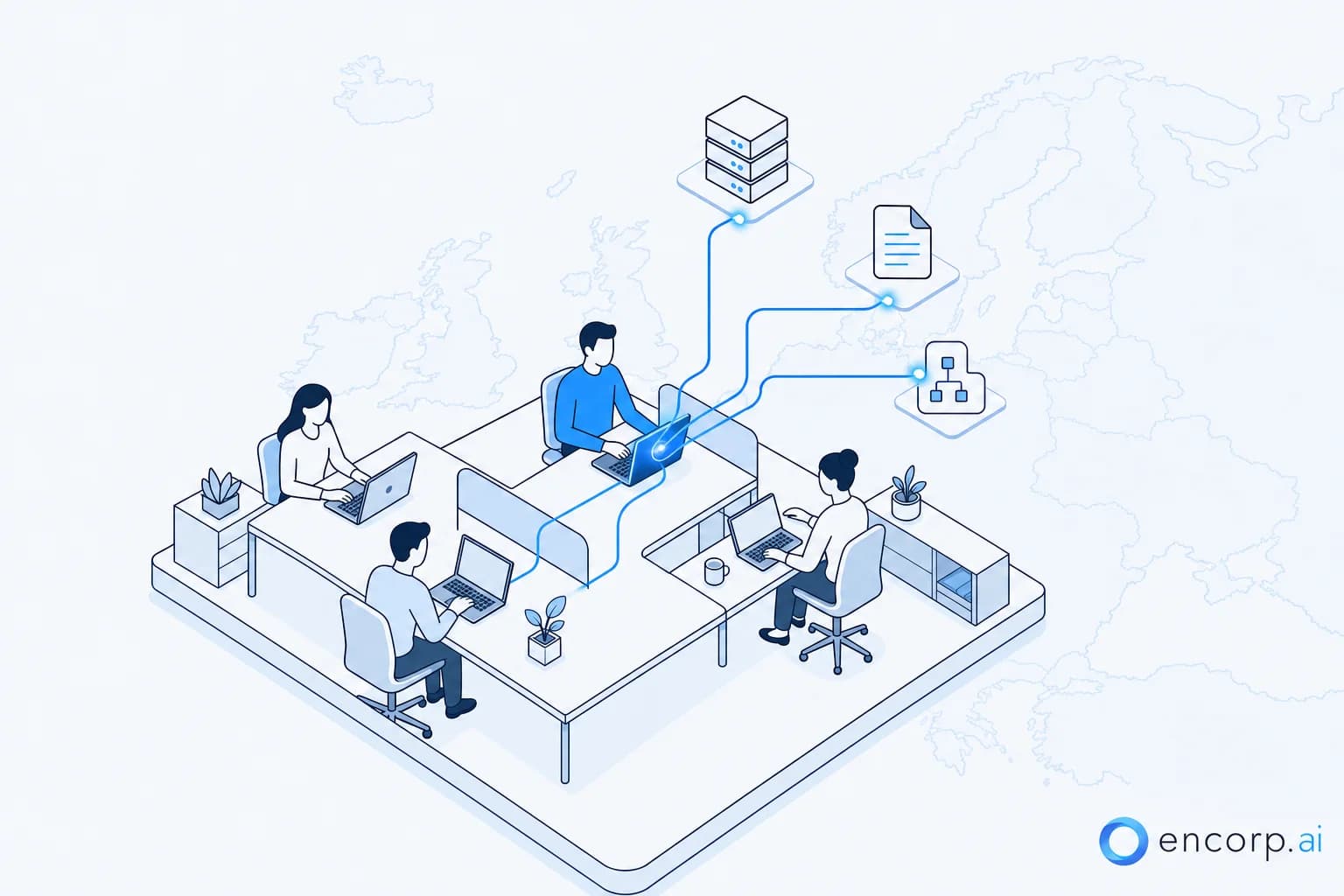
That person has a name in the industry: the forward-deployed engineer. The role comes from Palantir, where engineers embedded at customers do the deployment work while product teams build the platform. When a large European technology investor and a frontier model company back a new services business built around exactly this role, the signal is clear. Selling AI is no longer the bottleneck. Making it work inside a real company is.
What was announced, and what was not
It is worth being precise, because the announcement is short:
- The new company will be independent, will build on Claude, and will use forward-deployed engineers.
- Its stated goal is AI adoption and AI-native product build, "moving beyond pilots to measurable operational impact".
- It is described as "built for Europe", with a focus on companies operating across a complex mix of languages and regulators.
- Anthropic's Steve Corfield said that "businesses are looking for experienced teams to help them put Claude to work" (Hg).
What is not known yet: the name, the leadership, the size of the investment, pricing, which countries it will serve first, and whether it will work only with Claude or also with other models. Anyone making procurement decisions should treat it as a market signal, not as a vendor option, until it launches.
The numbers behind the bet
Eurostat's latest enterprise survey explains why investors see a services opportunity rather than a software one (Eurostat, Use of AI in enterprises):
- In 2025, 19.95% of EU enterprises with 10 or more employees used at least one AI technology.
- Adoption depends heavily on size: 17% of small, 30.36% of medium and 55.03% of large enterprises.
- Country spread is wide: from 42.03% in Denmark to 8.55% in Bulgaria, 8.36% in Poland and 5.21% in Romania.
- Among enterprises that had considered AI but did not use it, the most common reason was lack of relevant expertise (70.89%), ahead of unclear legal consequences (52.52%) and data protection concerns (48.83%).
Read the last line again. When seven in ten companies that wanted AI say the blocker is expertise, more model releases do not fix the gap. Engineers who can turn a model into a working process do.
For Central and Eastern Europe, this is the uncomfortable part. Bulgaria, Poland and Romania sit at the bottom of the table, and the EU Digital Decade target is for three out of four EU companies to use cloud computing services, big data or AI by 2030 (same Eurostat source). The distance between 8.55% and that target will not be closed by licences alone.
Why "forward-deployed" is the operative word
Most AI programmes in mid-sized companies follow a familiar path: a training day, a few licences, a pilot built by an enthusiastic employee or an external agency, a promising demo, and then a long pause. The pause usually happens at the same points:
- Integration. The pilot used exported spreadsheets; production needs live access to the ERP, CRM or document system, with permissions and audit logs.
- Ownership. Nobody in the business owns the outcome after the demo, and IT did not build it.
- Quality control. There are no test sets or evaluations, so nobody can say whether the system is good enough to trust.
- Regulation. Legal asks questions about the EU AI Act, which the AI Office and national authorities have enforced since 2 August 2026, and the project stops until someone answers them.
A forward-deployed model addresses these points by putting the engineer inside the client's own repositories, ticket system and cloud, with one agreed outcome and a handover at the end. It is closer to an embedded team member than to a consultant who leaves a report.
Where this hot take could be wrong
A fair argument needs its counterpoints:
- Funding is not delivery. The company has not launched. Its results will matter more than its press release.
- Vendor-aligned engineers have incentives. A team that builds "on Claude" will naturally reach for Claude. Companies with Microsoft 365 Copilot, Gemini or open models already in place should insist on model-neutral architecture and exit options.
- Embedded engineers can create dependency. If knowledge stays with the external team, the company has rented capability rather than built it. The engagement should end with code, documentation and trained people on the client side.
- Not every problem needs engineers. For many teams, the first step is still structured AI training, so people know what to ask for before anyone writes code.
Who should act, and how
- CEOs and COOs of companies with 30 to 300 employees: pick one workflow that costs real hours every week, and ask any partner to commit to that outcome in production, not to a demo.
- CIOs and CTOs of larger groups: check whether AI pilots have an owner, an evaluation set and a route through the normal release process. If not, that is the gap embedded engineers or internal hires must close.
- CFOs: compare the cost of a stalled pilot with the cost of finishing it. Budget for 2027 should include integration and operations, not just licences; ongoing monitoring of models and costs is what AI Ops covers.
- Boards and owners in Bulgaria and the wider CEE: the region starts from the lowest adoption base in the EU. Someone has to own AI as a business topic, which is the role of an AI Director.
A simple test before choosing any AI implementation partner
Whether the partner is a new pan-European company, a global consultancy or a local team, the same four questions separate delivery from slideware:
- Will the engineers work in the company's own tools? Its repositories, ticket system, cloud and release rules.
- What single outcome do they commit to, and how will it be measured in production?
- How will quality be proven? Ask for evaluation sets, logging and human review where decisions affect people.
- What stays with the company at the end? Code, runbooks, documentation and pairing sessions with internal staff.
Encorp.ai already works with this model from Sofia: forward-deployed engineers join a client's team in Bulgarian or English, ship one workflow to production and hand it over. For companies that want to test the fit on a specific workflow, the next step is a short call through the contact page.